Firearms Guide: Core Concepts for Builders
Firearms Guide: Core Concepts for Builders
Building a Glock-style pistol from a Polymer80 frame requires understanding the core parts and their functions. You can't assemble a reliable PF940C without knowing what a locking block does or why a connector angle matters. This guide breaks down the essential components and principles you need to handle, from calibers to controls.
Understanding Action Types: Striker vs. Hammer
The fundamental divide in modern handguns is between striker-fired and hammer-fired actions. Striker-fired pistols, like the Glock platform that Polymer80 frames are designed for, use a spring-loaded firing pin (the striker) that is partially pre-cocked by the racking of the slide. The trigger pull completes the cocking cycle and releases it. This design, used in our PF-Series frames, offers a consistent trigger pull, simpler mechanics, and generally fewer external controls. Hammer-fired pistols, like the 1911 or classic Berettas, use a visibly pivoting hammer that is cocked, either manually or by the slide, and then released by the trigger. This allows for features like single-action light pulls, double-action first shots, and manual safety/de-cocking levers. For a first-time builder, the streamlined, tool-less disassembly of a striker-fired system like the Glock is a significant advantage.
Caliber Selection: Balancing Power and Practicality
Your caliber choice dictates the frame size, parts kit, and intended use. For a Polymer80 build, 9x19mm Luger is the overwhelming standard for the PF940v2, PF940C, and PF940SC frames. It offers the best balance of manageable recoil, high magazine capacity, and ubiquitous, affordable ammunition. The .40 S&W, which uses the same frame size as 9mm in the Glock platform (e.g., a PF940C frame), delivers more energy but with sharper recoil and lower capacity. For a compact or subcompact build, .380 ACP (like the PF9SS build) provides very soft shooting in a tiny package. Larger frame builds, like the PF45, open up the potent 10mm Auto and the classic .45 ACP. My advice: start with 9mm. Its low cost for practice and wide parts compatibility make it the ideal platform to learn on.

Critical Components: From Frame to Barrel
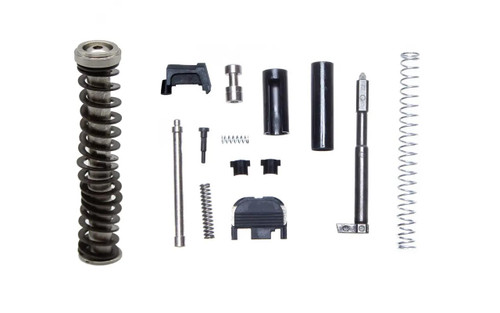
Every build revolves around a few key parts. The frame (like a Polymer80 PF940v2) is the serialized part you complete, housing the fire control group. The Lower Parts Kit (LPK) includes the trigger, connector, springs, and pins—the heart of the trigger feel. The slide houses the striker, extractor, and sights. The barrel dictates accuracy; look for a quality stainless steel or nitride-finished barrel with supported chamber. The recoil spring assembly is your gun's shock absorber; a standard weight is 18lbs for a full-size 9mm. Don't cheap out on the LPK or recoil spring. A poorly machined connector or a weak spring will cause immediate malfunctions, turning a rewarding build into a troubleshooting nightmare.
Safety & Operational Fundamentals
A firearm's primary safety is between your ears. The fundamental rules are non-negotiable: treat every gun as if it is loaded, never point it at anything you are not willing to destroy, keep your finger off the trigger until sights are on target, and be sure of your target and what is beyond it. Mechanically, understand how your specific action works. A Polymer80 build, mimicking a Glock, uses a "Safe Action" system with three internal safeties: trigger, firing pin, and drop safety. There is no manual safety lever. This means consistent, deliberate trigger press is paramount. Always verify your build with function checks: ensure the striker releases when the trigger is pulled, the connector resets, and the slide cycles smoothly by hand. Never assume a freshly assembled gun is ready for live fire without verification.

Maintenance & Reliability Checks
Reliability is earned through proper assembly and maintained through cleaning. After your initial build and successful function check, a thorough cleaning is mandatory. Remove all factory grease and metal shavings from the frame rails, slide internals, and barrel. Lubricate properly: a light coat on the frame rails, the barrel hood and locking block, and the connector. For a break-in period, I recommend 200 rounds of full-power 124gr ammunition, cleaning and inspecting after each range session. Check for unusual wear on the rails, ensure all pins remain seated, and verify the extractor claw tension. A reliable firearm is a clean, properly lubricated, and well-fitted one. Using a complete, quality parts kit from a known source like Polymer80 for your core components eliminates many variables from the start.
What is the difference between a complete slide and a slide parts kit?
A complete slide is a fully assembled unit: the slide shell, barrel, recoil spring, and all internal parts (striker, extractor, sights) installed and ready to mate with your completed frame. A slide parts kit (or upper parts kit) is a bag of all the small internal components needed to assemble a stripped slide shell you purchase separately. For new builders, a complete slide is the simpler, faster route.
Can I use any Glock parts in my Polymer80 frame?
For the common PF940 series (9mm/.40), most Gen 3 Glock components are compatible. Your Lower Parts Kit, locking block, and slide internals should be Gen 3 spec. However, the frame itself is not identical; it uses its own rear rail module and may require specific fitting of parts like the trigger housing pin. Always refer to the official Polymer80 instruction jig for your specific model.
What tools are absolutely necessary for a build?
At a minimum: a quality hand drill or drill press, a set of drill bits (3mm, 4mm, 5mm as per jig), a flush-cutting end snip for polymer tabs, a flat file and sandpaper (200-grit and up) for finishing the rails and channel, a small hammer, and pin punches. A vise to secure the jig is highly recommended. Do not try to drill the pin holes with a power drill freehand; you will ruin the frame.
Browse our firearms collection
Last updated: March 27, 2026